9 Extraordinary Uses for Objects in the Kitchen

Tuesday, August 16, 2011 0 comments

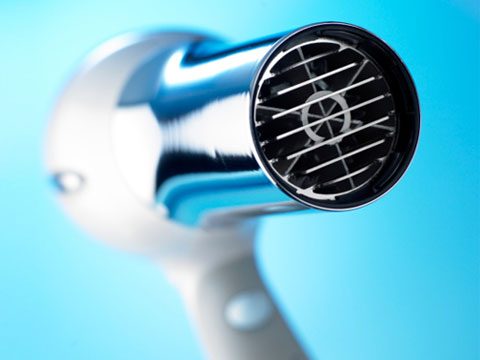
1. Hair dryer as salad drier

If you have rinsed and spun your salad, but the leaves are still wet, set your hair dryer on a cool setting and wave it gently over the leaves.

2. A teaspoon as a ginger peeler
When you find it impossible to peel ginger without losing some of the flesh, try this. If you're right-handed, hold the ginger in your left hand and, using a teaspoon, firmly scrape the edge of the spoon along the knob with your right. The papery skin will peel straight off.

3. Dental floss as slicer

Held taut, fine floss can slice layer cakes, soft breads, soft cheeses, butter and plenty of other soft foods more effectively than a sharp knife.

4. Plastic drink bottle as a funnel
Cut off the top third of the bottle and turn it upside down. Now you can easily funnel left - over sauces, gravies, kidney beans or even grease into containers for storage or disposal.

5. A coffee filter as a gravy strainer
Beef and poultry drippings from a roast make the most delicious, flavoursome base for gravy, but are often packed with grease. Save the flavour and lose the fat by straining the cooking juices through a paper coffee filter.

6. Scissors as herb chopper
Use clean household scissors to snip fresh herbs and spring onions into salads or mixing bowls. Scissors are also perfect for cutting steam vents in the crust of a pie before it goes in the oven.

7. Flowerpots as kitchen tool caddy
Store serving spoons, whisks, tongs and other kitchen tools in flowerpots on the benchtop. To make the pots more decorative, you could paint each one in a different pastel or bright color.

8. Wood rasp as lemon zester
A clean, fine metal rasp from a toolbox works perfectly as a zester for lemons, limes, oranges and other citrus fruit. Its tiny raised nubs scrape the fruit's skin to create perfect zest.

9. Shoehorn to remove corn kernels
A clean shoehorn has at least two uses in the kitchen: scrape the wide end along a cob to remove the kernels and use the narrow end to gently release baked goods such as cupcakes, small pies or muffins from their tin.

User food review: Faux Healthy Fast Food - Arby’s Angus Deli Sandwich

0 comments

Visit foodreview101.com for more food reviews and food news!

Arby's really isn't the first thing you think of when it comes to healthy fast food although they do have some healthy menu items when it comes to their roast beef sandwiches. The chain has recently introduced a new Angus Cool Deli Sandwich sandwich and an Angus Cool Deli Wrap which both look promising in the advertisements as well as on their web-site. The main question is if Arby's would be able to create a fresh and healthy sandwich that would live up to the advertisements that are promoting them as such, or if they would just be another item on the menu.

When you look at what they're advertising it's hard not to think that this sandwich would be pretty tasty right?, wrong. What we found out first hand was that the meat wasn't as nice as we'd hoped it would be and have come to expect from eating Arby's meat all these years. The fixing's that go into this sandwich are what sets it apart from some other fast food sandwiches these days because it's "Topped with crisp lettuce, tomato, red onion, Swiss cheese, mayonnaise, dressed in vinaigrette and popping with banana peppers and pickles." All of these ingredients combined together made a nice flavor combination, however the sandwich it-self was kind of large and had that effect of being too large to eat. This sandwich falls in the line of other fast food items such as Wendy's new Berry Salad or Shakes. If you're looking for a healthy fast food sandwich we suggest you make your own and take it to work or to keep going to Subway and ordering off their Under 500 Calorie Menu. Overall (2 out of 5).

The pros are that the fixing's in the sandwich are a nice touch.

The cons are that the meat isn't that great, the sandwich is plain big, and it's a fake healthy sandwich.

Nutritional Information:

  • Calories 640
  • Fat 35g
  • Sodium 1760mg
  • Carbs 47g
  • Fiber 3g
  • Sugar 4g
  • Protein 37g

Secret Ways Restaurants Use Music

0 comments

Music most likely isn't the largest factor motivating where you choose to dine, but restaurant owners put a lot of thought into what they play in their eateries. And according to Nation's Restaurant News, if they aren't thinking about music, they should be.

In a recent post about music's role in restaurant design, author Mark Brandau details the different ways sound influences sales, how different times of the day call for their own soundtrack and how restaurants cater to certain clientele. Here are a few "notes" to keep in mind the next time you need to pick a restaurant:

It's someone's job to craft playlists. Eateries hire experts to build music playlists for different times of the day. Says the Senior Vice President of Quaker Steak & Lube, "Energetic, up-tempo songs encourage quick dining and faster table turns at peak periods." These paid-for playlists don't include commercials and need to be scored so there's enough variety to avoid repeating songs.

What you hear at lunch won't be what you hear at dinner. And what you hear after dinner will be something entirely different. If a restaurant's goal is to increase late-night traffic, music is crucial to creating the atmosphere.

Music builds brands. Nick Vojnovic, president of four-unit, fast-casual chain Little Greek, had been in the business 20 years before realizing how crucial music is to the restaurant experience after listening to an executive from The Cheesecake Factory speak about using music to strengthen brand identity.

Where have you heard that before? Restaurants may be using the same music providers. Ambiance Radio provides playlists for Little Greek, in Florida, and also Schlotzsky's and Union Square Café, in New York City. Vojnovic, who started his career at Chili's, revealed that years ago, instrumental tapes of background music were changed only once per quarter.

Music helps restaurants choose diners. Brandau explains that some restaurants prefer to pump up the volume, not to alienate certain groups of customers, but to stay true to their core guest. If college kids are a restaurant's prime demographic, the establishment may deliberately play music older crowds deem uninviting.

Apricot Lamb Meatballs

0 comments

I adore lamb but don't buy it very often because it can be expensive.  When I saw it for $3.98/lb. at our local grocery store on Saturday, I jumped at the chance to make one of Man Friend's and my favorite dishes -apricot lamb meatballs with couscous and tomato and cucumber salad.

I always start out by assembling the meatballs and couscous per the recipe below.

Apricot Lamb Meatballs

yields 12-14 2 inch meatballs

  • 1 lb. ground lamb
  • 1/2 t. cinnamon
  • 2 t. cumin
  • 1/4 cup crumbled feta
  • 1/3 cup bread crumbs
  • 3/4 small onion, finely minced
  • 6 dried apricots, chopped
  • 3 cloves garlic, minced
  • 1 egg, beaten
  • 3 T. chopped mint
  • 2 cups couscous

meatball ingredients

Preheat oven to 425 degrees.  Add all ingredients except the mint and couscous  into a mixing bowl and mash together.

meatball ingredients in bowl

Add the mint and gently mash it into the lamb mixture.

meatball ingredients in bowl with mint

Form the lamb mixture into two inch wide meatballs and place them in a baking dish.

meatballs ready for oven

Bake for 20 to 22 minutes, turning once halfway through cooking time.  The meatballs should be browned evenly when finished cooking.  If you're not sure that they're cooked, you can always slice into one to see if there is any pinkness in the middle.

cooked meatballs

While the meatballs cook, you can get started on the couscous.  Cook 2 cups dry couscous per the instructions on the package.  When you remove the couscous from heat, drizzle 1 T. olive oil into the water and couscous so it is absorbed as the couscous cooks.  When the couscous has absorbed all of the water and oil, fluff it lightly with a fork.

couscous

Along with couscous, my favorite thing to serve with the meatballs is a simple tomato, cucumber, and feta salad.  It adds a ton of color and freshness to the plate and really completes the meal.  See recipe below.

Tomato, Cucumber, and Feta Salad

  • 5 medium size tomatoes, diced
  • 1 whole English cucumber, chopped
  • Juice of 2 lemons
  • 3 T. olive oil
  • 1/4 cup crumbled feta cheese
  • 2 T. chopped mint

salad ingredients

Mix cucumbers, tomatoes, feta, and mint together in a bowl.  Toss with olive oil and lemon juice just before serving.

prepared salad

When everything is ready, pile your plate high!

assembled plate

This dish is such a special treat, and yet it is really quite simple to make.  I love how the sweetness from the apricots is nicely complimented by the cinnamon and the warm smokey flavor of the cumin in the meatballs.  I always mix everything together when I eat so that the couscous is infused with the citrus dressing from the salad.  It gives so much freshness and fragrance to the meal.  Plus, the mint and feta in both the salad and the meatballs nicely ties the two components together.  Enjoy!

If you enjoyed this post, please head over to www.flopoodle.com for more recipes!

8 hidden food dangers and how to avoid them

0 comments

By Hilary Meyer, Associate Food Editor, EatingWell Magazine

Some people think that rules are made to be broken. In certain circumstances, I can get behind that statement. But when it comes to food, if you take that attitude to heart, understand you could be risking your health. I'm paying closer attention to food safety these days in the wake of the recent salmonella outbreak that's been linked to ground turkey. To date, Cargill Meat Solutions Corporation has recalled 36 million pounds of ground turkey, which is no small number.

Whether we realize it or not, chances are we all have broken a few food-safety rules. It's easy to do, but also easy to avoid if you know about which hidden food dangers to watch out for and what you can do to protect yourself:

Danger: When there's a recall, you don't check your food
Avoid it: We often hear about food recalls on the news, but according to a survey conducted by Rutgers University during the fall of 2008, only about 60 percent of Americans search their homes for foods that have been recalled because of contamination. Whenever there's a food recall, check products stored at home to make sure they are safe. You should discard any food that's been recalled because it's associated with the outbreak of a foodborne illness. For more information on food recalls, visit www.recalls.gov.

Related: Signs and Symptoms of 5 Foodborne Bacteria You Want to Avoid

Danger: Your refrigerator isn't cold enough
Avoid it: Especially in the summer months, the temperature in your fridge can creep up. Use a "refrigerator thermometer" to make sure your food is stored at a safe temperature of 40°F or below. Keep in mind that products stored on the refrigerator door are subject to the most temperature fluctuations. Store highly perishable ingredients like meat toward the back of your refrigerator or in a meat drawer.

Danger: You defrost food on the counter
Avoid it: It's summer. It's warm. You think you can expedite the thawing of your frozen hamburger patties by leaving them on the counter for a little while. Right? Wrong! Perishable foods should never be thawed on the counter for longer than 2 hours because, while the center of the food may remain frozen, the outer surface may enter the Danger Zone, the range of temperatures between 40° and 140°F, in which bacteria multiply rapidly. If you're short on time, use the microwave—or you can thaw meat and poultry in airtight packaging in cold water. Change the water every half hour (so it stays cold) and use the thawed food immediately.
Don't Miss: 4 "Bad" Cooking Habits You Should Break
10 Secrets to Healthier Cooking

Danger: You use the same cutting board for everything
Avoid it: Most people know that it's good practice to give their cutting board a wash after it comes in contact with raw meat or poultry, but it's a better idea to use separate cutting boards for raw meat/poultry/fish and produce/cooked foods. That way, bacteria from uncooked meat, poultry and fish won't contaminate cooked foods and fresh produce.

Must-Read: 10 Food Rules You Should Follow

Danger: You assume your meat is cooked rather than using a thermometer to check
Avoid it: Using a calibrated instant-read thermometer is the only way to really know if that burger is cooked through. The USDA Recommended Safe Minimum Internal Temperatures are as follows: beef, veal and lamb (steaks and roasts), pork and fish, 145°F; ground beef, 160°F; poultry, 165°F. In the EatingWell Test Kitchen we often recommend cooking meats like roasts and steaks to lower temperatures, closer to medium-rare, so that they retain their moisture. However, we recommend that those who are at high risk for developing foodborne illness—pregnant women and their unborn babies and newborns, young children, older adults, people with weakened immune systems or certain chronic illnesses—follow the USDA guidelines.
Test Your Food-Safety IQ: How Many Food Rules Do You Break? Take Our Quiz!

Danger: You give your hands a quick rinse before you cook
Avoid it: Sometimes we're pressed for time and we cut corners. One of these corners could easily be skimping on the soapy water you need to wash your hands properly. You can pick up a lot of bacteria out in the world, so it's important to always wash your hands before you eat or prepare food. You should also wash your hands after touching any uncooked meat, poultry, fish or eggs, as bacteria from these foods can contaminate cooked foods and fresh produce. Use soap and warm water and wash thoroughly—for at least 20 seconds.

Danger: You eat your leftovers cold
Avoid it: Watch out for that slice of cold pizza that's lurking in the fridge! The USDA recommends heating all cooked leftovers to 165°F to kill all potentially dangerous bacteria.

Danger: You eat foods that have been sitting out too long
Avoid it: Keep an eye on the buffet table at your next potluck. Meat, poultry, eggs and even sliced fresh fruits and vegetables that have been left out for more than 2 hours may enter the Danger Zone—the unsafe temperatures between 40° and 140°F, in which bacteria multiply rapidly. And in temperatures hotter than 90°F, food can become contaminated in half that time. Move perishable foods back to the refrigerator as soon as possible to avoid spoiling.

How concerned are you about food safety in light of the recent turkey recall?

No-fail ways to grill 8 vegetables (plus 5 seasonings you haven’t tried)

0 comments

By Hilary Meyer, Associate Food Editor, EatingWell Magazine

I love roasted vegetables, but it's way too hot to even think about turning on my oven. So in the summer, I leave some room for vegetables on the grill.

Grilling vegetables imparts a delicious smokiness that can't be replicated by any other cooking method. And if your grill is already fired up for your main dish, why not take care of the side at the same time?

Recipes to try: Prosciutto-Wrapped Asparagus & More Grilled Vegetable Recipes
Grilled Eggplant and Portobello Sandwich & More 30-Minute Grilling Recipes

EatingWell's Test Kitchen team pulled together a chart of the 8 easiest vegetables to grill and how to prepare them for perfect results every time. Just follow these simple steps:

Step 1 – Preheat your grill to medium-high. Prepare the vegetable of your choice from the chart below.

Step 2 – Brush the vegetable with 1 tablespoon olive oil or canola oil and sprinkle with 1/4 teaspoon salt and pepper – or with one of the flavor combinations below.

Step 3 – Grill the vegetables, turning occasionally, until lightly charred and tender (check the chart for approximate grilling times).

Don't Miss: Gas or Charcoal? Our 13 Best Grilling Tips
4 Secrets for Perfect BBQ Chicken

Want more flavor from your veggies? Slather on one of these combos before you grill:

Chile-Garlic & Soy: Toss vegetables with 4 teaspoons extra-virgin olive oil (or canola oil), 1 tablespoon each chile-garlic sauce and reduced-sodium soy sauce and 1/8 teaspoon ground white pepper.

Chili-Lime: Toss vegetables with 4 teaspoons extra-virgin olive oil (or canola oil), 3/4 teaspoon each chili powder and ground cumin and 1/2 teaspoon salt. After grilling, toss with 2 tablespoons chopped fresh cilantro and lime juice to taste.

Garlic-Thyme: Toss vegetables with 2 tablespoons extra-virgin olive oil (or canola oil), 1 tablespoon chopped fresh thyme (or 1 teaspoon dried), 1/2 teaspoon garlic powder and 1/4 teaspoon each salt and freshly ground black pepper. After grilling, toss with 2 tablespoons chopped fennel fronds if desired.

Maple Butter: Toss the vegetables with 2 tablespoons pure maple syrup, 1 tablespoon melted butter, 1 1/2 teaspoons lemon juice 1/2 teaspoon salt and freshly ground pepper to taste.

Spicy Orange: Toss vegetables with 4 teaspoons extra-virgin olive oil (or canola oil), the zest of 1 orange, 1/2 teaspoon salt and 1/4-1/2 teaspoon crushed red pepper.

Recipes to Try: Blueberry-Bourbon Barbecue Sauce & More BBQ Sauces, Marinades and Rubs

What vegetables do you like best on the grill, and do you have a special way you like to prepare them?

 
My Fitness For You © 2011 | Designed by Interline Cruises, in collaboration with Interline Discounts, Travel Tips and Movie Tickets